Haemoglobin change
(LS mean change from baseline)
Difference0.14 g/dL
95% CI
−0.1304
to 0.4202
Prespecified
non-inferiority
met

Evidence and dosing for adults receiving dialysis
Indicated for the treatment of anaemia in adult patients with chronic kidney disease (CKD) on dialysis.1
OXEMIA® (desidustat) is an oral HIF-PH inhibitor taken three times a week.
This page is for healthcare professionals.
Refer to the PI before prescribing.
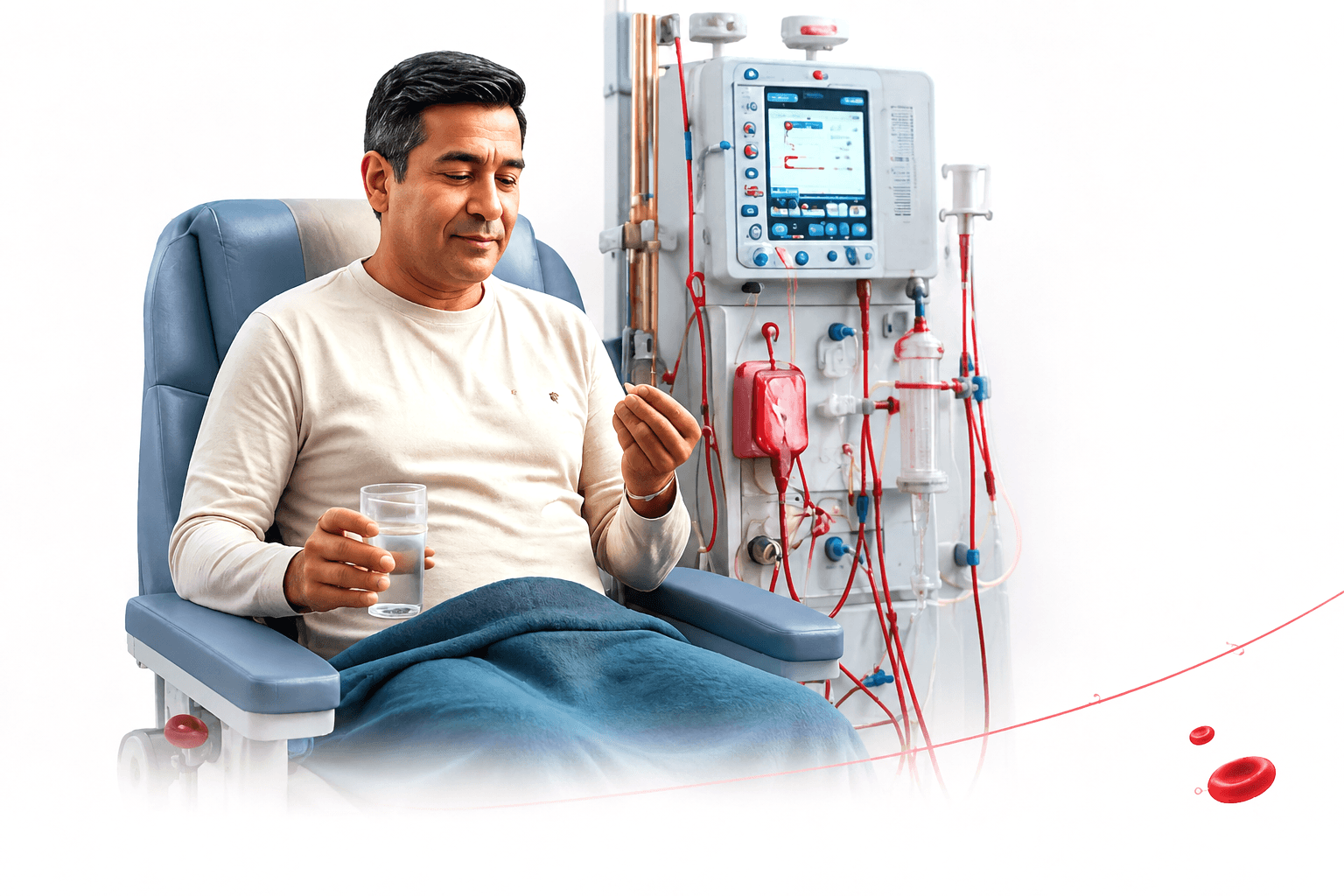
Stage 5 CKD has a high prevalence of moderate to severe anaemia.

Blood loss during dialysis from the circuit and sampling.

Chronic inflammation and infections can increase hepcidin levels.

Iron may be present in the body but less available for red blood cell production.
Kidneys produce less erythropoietin, leading to reduced red blood cell production.
392 patients
38 centres across India
Randomised, open-label, active-controlled
24 weeks
Desidustat oral tablets vs epoetin alfa injection
Target haemoglobin in the study: 10–12 g/dL
(LS mean change from baseline)
95% CI
−0.1304
to 0.4202
Prespecified
non-inferiority
met
(Patients achieving target Hb 10–12 g/dL)
59.22%
Desidustat
48.37%
Epoetin alfa
p = 0.0382
The safety profile of desidustat was comparable with epoetin alfa.
No new or increased risks were observed versus epoetin in the study.
Results are from the DREAM-D phase III study. Individual results may vary.
Read DREAM-D studyStart Desidustat
100 mg
three times weekly
Select starting dose based on previous ESA dose
Give after completion of dialysis session
Reassess haemoglobin every 4 weeks and adjust dose
Do not consume any food 1 hour before and 2 hours after taking OXEMIA®.
Doses to be taken 2 days apart (examples below), not 4 days apart.
No food 1 hour before dose
No food 2 hours after dose
Take after completion of dialysis session.
Desidustat might be offered as an alternative to ESAs for dialysis-dependent patients with CKD who do not prefer ESAs.

Multicentre retrospective study in CKD patients including dialysis recipients.
See dialysis outcomes in routine practice
Low certainty evidence for key clinical outcomes with HIF-PH inhibitors in non-dialysis CKD.
Review the systematic evidence
Desidustat in EPO-induced PRCA: small case series, research context only.
Go to research libraryAccess adverse events tables, serious adverse events and study safety details.
View safety tablesFor full safety profile, contraindications, precautions, drug interactions and monitoring recommendations.
View safety informationView approved indication, dosing, administration, warnings and precautions.
Download PI (PDF)For scientific enquiries or medical information.
Contact Medical Affairs